
Prabhat Patnaik Keynote Lecture at the Launch of the Study ‘The Cooperative Movement in Kerala’
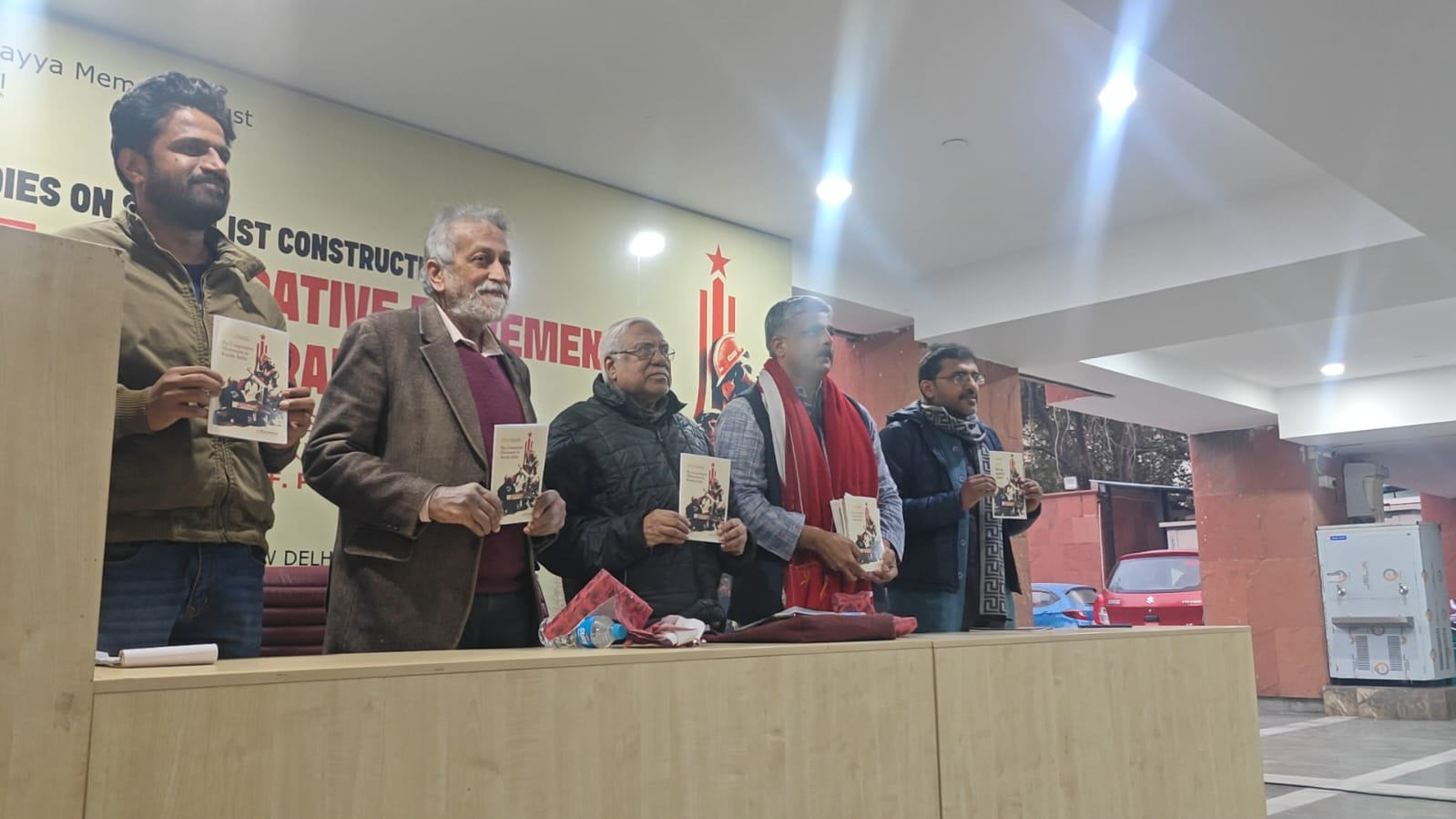
This lecture was delivered on December 16, 2025 at the launch of the study The Cooperative Movement in Kerala, India organised by P Sundarayya Memorial Trust and Tri-Continental Institute for Social Research at HKS Surjeet Bhawan, New Delhi.
Distinguished comrades on the dias, comrades and friends!
First of all, I’m extremely grateful that I have been given this opportunity to come and release the book and also to share some thoughts with you, which I have been having for a very long time. As Comrade Dhawale said Kerala was one of the states in which the cooperative movement was assiduously promoted by the Left because of which, while in many other states, the cooperatives essentially have turned into fiefdoms of individual political figures, in Kerala, they remain a means of an instrument of class assertion, and this is something which comes out very clearly from the study, from the case studies in this particular volume [The Cooperative Movement in Kerala, India], whether it is Dinesh Bidi, whether it is Kudumbashree, whatever it is tea workers, peasants growing tea, you find that there is a class assertion which occurs because of the cooperative movement.
Now I think the cooperative movement today has acquired again, as comrade Dhawale pointed out, has really acquired an enormous importance, particularly in the context of the neoliberal policies which are being pursued. The essence of the neoliberal policies is an attack by big capital on petty production including peasant agriculture.
Now, this attack takes the form not only of removing input subsidies, not only of removing price support, not only of removing extension services, not only of removing, the support that the government used to provide in the form of investment in infrastructure, in the form of extension services, catering to the distribution of seeds and so on, but also it takes the form of really taking over, squeezing the peasant agriculture sector, petty production sector. For instance, we know that cash drop prices fluctuate greatly in the international market. Now, earlier, the cash growers were protected against these price fluctuations because of the fact that we had various bodies that intervened in periods when crisis in the world market crashed and we had quantitative restrictions on imports, we had tariffs and so on, which actually adjusted domestic prices in a manner that international price fluctuations did not really affect the domestic growers. We had Tea board, Coffee Board, Coir Board, Rubber Board, all these boards had a marketing function. As a result of neoliberal policies, the boards continue to exist, but the marketing function has completely disappeared. Because of which international price fluctuations, which are very, whose altitude is very high in the case of cash drops, they make themselves felt in the domestic market. And since cash crop growing is typically associated with substantial amounts of credit, the farmers are not able to pay back credit in years when the cash crop prices crash because of which then they commit suicides.
So very large numbers of farmers suicides are of cash crop farmers. I’m not saying only of cash drop farmers, but cash crop farmers really form the bulk of the peasants who have committed suicide. Even in the case of food grains where the government tried to do away with the minimum support price (MSP) mechanism and was prevented from doing so because of years of farmers agitations.
Even there, the prices which the farmers have got really are extraordinarily low. I’ll give you an example, which is quite striking. When I joined Jawaharlal University in 1973, I joined as an associate professor. The basic salary of an associate professor was Rs 700 per month. At that time, the procurement price of wheat let us say was about Rs 70 to 75 per quintal. Today, the procurement price for wheat is about Rs 2,200 – 2,500 per quintal. So roughly, let us say it has gone up by 30 times. If one was the price in 1973 of the procurement price per quintal, today it is about thirty. But the basic salary of an associate professor in a Central University today is about Rs 1,50,000. 700 to 1,50,000 is in fact a 200 times increase. And academics in India are not a pampered lot. They’re not among the highest paid. We have all read stories about the incredible increase in income and wealth inequalities where a Hollywood star is invited to perform in a wedding. And he is paid Rs 17,00,00,000 – 18 00,00,000 for one night’s performance. So that is the kind of inequality we are talking about.
And in that, while the academics are not among the pampered lot, nonetheless they are in a better position than the peasants. As I said, one is to 30 compared to one is to 200. So it just shows how badly the farmers have been treated in the entire neoliberal period.
It’s not surprising that a very large number of them have actually given up agriculture, about 15 million. If you compare 1991 census with the 2011 census, the number of cultivators in the 2011 census is 15 million less than in 1991. Some of them may have become labourers, others would’ve migrated to cities in search of jobs, which again are non-existent because the employment growth or the job growth has even though we talk much, the government talks much about the acceleration in GDP growth, the employment growth, the job growth has actually decelerated compared to the earlier period. In the earlier period, it was about 2% per annum was the magnitude of job growth we used to criticise it, saying that, look, population growth is about that much, a little bit more than that, if anything, which basically means that the workforce growth wouldn’t be about that much. And therefore your job growth is just about keeping up with, or is marginally short of the workforce growth, in which case the enormous amount of reserve army of labour that we inherit from colonial times is not going to be used up. So our criticism of the Nehruvian strategy was that look you’re simply not doing enough to absorb the backlog of unemployment that constitutes a reserve army of labour. While now, the job growth has actually become less compared even to the earlier period while there is some slowing down of the rate of growth of population, therefore the workforce. The rate of growth of workforce is still higher than the rate of job growth in which case the reserve army of labour instead of getting reduced in relative terms, is actually increasing and thereby poverty is increasing.
There is a massive obfuscation on the issue of poverty. And then you find all these complete nonsense, which has been spread that, you know in India, poverty is now five percent and is going to disappear in five years’ time and so on. It is complete nonsense. You actually find that the fundamental poverty defined in terms which the Planning Commission itself had used in 1973 -74, namely the number of persons who have access to 2200 calories in rural India and 2100 calories in urban India. That proportion has increased significantly between the introduction of neoliberal policies and now therefore, you have a rise in reserve army of labour. A rise in the magnitude of poverty. The the rise in the relative size of the reserve, army of labor rise in the magnitude of poverty.
And all this is associated also with a massive attack on peasant agriculture and petty production in general.
The point is that, that against this attack on peasant agriculture, so far we have been talking in terms of, I mean, you know, the strategy has been to mobilise the presence politically against this attack, which of course is absolutely right. Correct. Desirable and deserves priority. But at the same time, it seems to me that political mobilisation of the peasants is just not enough. What we need is a new set of institutions in rural India, which would play the role, and this is true of petty production in general as well, but I’ll confine myself to talking about peasant agriculture. We should play the role of actually providing an alternative, which could actually play the role of stiffening the class resistance of the peasants in addition to the political struggle that they’re carrying on because political struggle still does not overcome the fact that they are individual peasants. Their individual atomised nature is not overcome. They’re politically united, but in terms of basic production units, they remain individual atomised production units. But I think something has to be done about overcoming the state of individual atomisation. This has been a long debate in India, not recently. When I was a student in Delhi University, there was an intense debate on the whole question of cooperatives. There was one school of thought, which argued that, look, the small farmers have higher productivity per acre. This is something with the Farm management surveys of the 1950s had disclosed that the productivity per acre on small farms was higher than the productivity per acre on large farms.
Since India was an economy which was constrained by the size of land. If you want to increase agricultural output. In that case, you cannot really have large farms, even cooperatively own large farms because of the fact that, that actually gives you lower productivity per acre. Putting differently, since land is a constraining factor, if you want to increase the size of agricultural output. Then your objective should be to maximise the output that is obtained from an acre of land. That means productivity per acre, and if you want to maximise the productivity per acre, then any form of destroying individuals small farms and converting them into large cooperative units is something which is undesirable.
On the basis of this, many people had argued that what you need, of course, to support the peasantry is service cooperative. You can have cooperative credit societies, cooperatives marketing societies and so on. But services can be cooperative wise. Cultivation should remain individual. This was a position that was taken by many people, including Professor Raj Krishna, who distinguished agricultural economist in Delhi University. And this was also the kind of position against any form of cooperative production that was taken by Chaudhary Charan Sing who had written a very important book at that time called Cooperative Farming X Rayed [Joint Farming X-rayed] [He also wrote a book, Whither Co-operative Farming] against this however, there was a major kind of criticism from the Left and of course from many economists sympathetic to the Left. For instance, Professor A M Khusro, who later became Vice Chancellor of Aligarh Muslim University, had written an important book on cooperatives [along with A M Agarwal – The Problem of Co-operative Farming in India], which was really inspired by what was happening in China in those days.The whole argument of that book was that, look, when you have cooperatives. Then you can actually mobilise large numbers, large amounts of unused resources. For instance, in a particular household, you may have a person who has some idle time. In some other household, you have a person who has some ideal time. This ideal time in individual households cannot be converted into anything, doesn’t really produce anything. But if you aggregate this ideal time across many households, in that case, you would be able to obtain a supply of labour that can be used for capital formation, that can be used for bunding (to arrest water flow from a pond or lake), that can be used for digging channels, that can be used for fencing(agriculture land etc) and so on, whatever. So, you can actually build capital projects through an aggregation of unused resources, which would otherwise remain unused if you could actually have a cooperative form of organising production. This argument, which of course was very important at that time, because the Chinese experience with communes, the communes created an enormous amount of capital in addition to, I mean, for instance, if you have a commune, there would be a certain amount of planned funds that will come to the Commune for capital projects, you had a centrally planned economy. The planned economy would, let us say, allocate a certain amount to a particular commune that comrades to use these funds for, for doing A, B, C of capital projects. But in addition to the planned funds, there was, because of the existence of communes there was all these utilisation of local resources, which were lying unutilised otherwise. And this actually contributed a fair proportion of the total capital expenditure. Almost 20% of total capital expenditure in many communes was really generated within the commune itself, which did not depend on central planning or central devolution of planned funds.
Exactly the same argument was put forward that in India, if you have an aggregation of these unused resources, which is possible, if you can have organisation of production on a cooperative or a collective basis, in that case, you would be able to generate capital in addition to anything that central funding may provide you. And thereby raise productivity. Now this argument was actually part of another bigger argument which had been put forward by Lenin. This idea of size productivity, the size productivity debate is not something specific to India. It is something which you find all over the world. And this idea of small size being more productive in terms of productivity per is something which Lenin had actually discussed. And had refuted, because Lenin had said that really you, why are you looking only at the size of the plot? You should really look at the scale of agriculture. You have a small pot plot in which there is a substantial amount of capital investment. You can have a small plot in which there is very little capital investment. Therefore, simply looking at size is not enough. You have to look at the scale. And if you look at the scale, then you’ll find that higher scale of production is something which is more economical, more efficient, that that instead of smaller size of farms being more efficient, higher scale of production is more efficient. Distinction in size and scale on the basis of which there was a paper which was written by Comrade Utsa. That you know, it is called ‘Economics of Farm Size and Farm Scale: Some Assumptions Re-Examined’, in which she actually found evidence that in India, if you forget about size, you simply look at the scale of operation. Then you find that larger scale farm scale of operation, you could take a proxy for larger scale in the form of larger value of output. Larger farms tended to have higher productivity per acre. Larger farms, in scale terms, not in size terms, tended to have higher productivity per acre compared to smaller farms, which was really a confirmation of what Lenin had found much earlier. Now, if that is the case, then this whole argument that you know that, that if you aggregate small farms into cooperative production units. If organisational production takes the form of building cooperative and, pooling land, in that case, you would lose out in terms of productivity per acre. That argument becomes invalid because the point is you that you’re not just pooling, but you are actually increasing the scale of production.
Now that being the case, it seems to me that there is a very strong, powerful argument for introducing not just service cooperative, not just cooperative related marketing, but introducing production cooperatives. And the Left I think should take this out. And what is more, of course we know. That in any situation where the workers and peasants come to power, you would have to have higher forms of property supplanting, individual peasant property in the transition to socialism, but even before the workers and peasants have come to power, I think the preparation for building these kinds of production cooperatives must begin right now because it’s a way of preventing the decimation of individual peasant agriculture by capitalist farming or by agri-business, which then tends to dominate the peasants if you have, in fact, cooperative would not only be, in that sense, productively more efficient, but they would also be able to counterbalance the power of agribusiness, even in the society in which we live, because they would be having much greater bargaining strength compared to the individual peasants. There is a further argument, why I believe that institutional changes, and not only important, but should be introduced right now, wherever the Left is in a position to usher in such changes.
After all, we don’t visualise. That a peasant would always remain a peasant. We don’t visualise that a peasant’s child would always remain a peasant’s child. I think that’s ridiculous. We have to have a situation in which the distinction between the town and country must disappear. True, that is a long, long-term goal. But on the other hand, everything we do must be informed by that basic long-term goal. That, the peasants are not a separate category forever remain as peasants, that we have to have the obliteration of the distinction between town and country. Now, if we are going to do that, in that case, not only is it very important that industrialisation must come to the countryside. But what is more industrialisation in the countryside must not be at the expense of the farmers, must not be at the expense of the peasants. I think at the moment, one of the biggest problems being faced by the country is the disposition of peasants by monopoly houses who then start industries in the agricultural, in rural areas and get rid of the peasants paying them some compensation which is not really particularly satisfactory from their point of view. And which certainly is not enough to necessarily give them a living forever. Now, if that is the case, that has been the cause for substantial peasant unrest. I should add that if the substantial present unrest has occurred, not only in India, it also occurs in other countries of the Global South, including even in China.
Now, therefore, if we are going to think. The problem, the classic problem we faced, for instance in West Bengal, the Left faced in West Bengal that you want to industrialise, but if you want to industrialise in that case, the peasants have to give up land in order to set up factories. And if the peasants give up land, then they resist this giving up. And therefore if the Left supports industrialisation, the Left loses its support within the peasantry, which the kind of thing that actually, the kind of dilemma that we actually faced in West Bengal. Now, I think this dilemma can be broken if you actually have peasant cooperatives also industrialising.
After all, Mr. Adani or Mr. Ambani or Mr. Tata, they don’t know anything about engineering. They hire people who can then kind of, you know, set up plans, design them, and so on and so forth. Why can’t a peasant cooperative do it? Why should it be that the task in setting up industry should be interested only to a group of monopolies? This task is something which can be taken over by institutions in rural areas themselves. In which case, what the peasants would lose in terms of land use, the gain in terms of ownership of industry. This, of course, cannot be done by individual peasants, but forming cooperative would be an easy way of transiting to this kind of an industrialisation where the distinction between town and country would disappear. And that disappearance and the distinction is absolutely essential because we don’t want a situation where, as I said, the peasant children remain peasant children forever. And so, and from that point of view, and of course one can say that you can have, you have other institutions in China, for instance, you had TVEs (Township and Village Enterprises).
Similarly, you can have Panchayats owning industry that is not necessarily that cooperative should, but then we should have a multiplicity of institutions. And since we are talking about the loss of land, the loss of rights over land for the sake of industrialisation, it is best if the loss of rights over land is something which is were counterbalanced by a specifically peasant organisation. As I said, individual peasants cannot do this, but on the other hand, it’s something which can be done if you have a cooperative. If you have a cooperative that in the cooperative individual peasants have already given their land.
I’m talking about production cooperative. There’s no question of finding out how much compensation to give to this person, how much compensation to give to that person. The point is the cooperative has been informed and the cooperative can then initiate industrialisation on its own.
I think that that is, that’s a way of breaking this deadlock, which has afflicted the progress of the Left in West Bengal, which has cost us [CPI(M)] heavily in West Bengal and so on, Because the peasantry had supported us solidly for three decades or more. But on the other hand, the fear of losing land is what actually alienated the peasantry from the Left.
And I think that the whole problem can overcome If we can think in terms of the peasants themselves owning industry and the peasants can own industry only as a cooperative unit. There are, therefore, it’s very important at this juncture, if we are going to fight in neoliberalism, if we’re going to fight the capitalist encroachment on petty production, which is the hallmark of neoliberalism, that we actually try our best to promote new institutions, particularly cooperative institutions and cooperative institutions not just in the sense of service cooperative but cooperative institutions of production as well. And that, as I said, would also stand us in good stead when we have a government of workers and peasants, because then the transition towards more cooperative collective forms of ownership, which is essential in the transition to socialism from individual petty ownership, would become that much easier.
So these are some thoughts which have been agitating me for a long time, and I’m glad I got a chance to share them with you. Thank you very much.
(Prabhat Patnaik is Professor Emeritus from Centre for Economic Studies & Planning (CESP), Jawaharlal Nehru University, New Delhi)